


Contact our Global Team
The global fitness equipment market is becoming more demanding, and buyers now expect measurable quality. According to the Health & Fitness Association, 72.9 million Americans belonged to a fitness facility in 2023. That figure signals sustained demand for commercial training equipment, including Gym Trampoline systems. Growth alone does not guarantee dependable purchasing decisions.
A reliable supplier must prove more than factory capacity. Buyers should examine frame materials, spring protection, mat resilience, welding quality, and replacement-part availability. ASTM F381 and EN 13219 provide useful safety references for trampoline equipment. They can support technical comparisons, although certification claims still require careful verification. The ISO Survey also shows the broad adoption of ISO 9001 quality management systems worldwide. However, a certificate cannot replace product inspections, sample testing, and factory communication.
This guide, “2026 Top Gym Trampoline Suppliers for Global Buyers,” evaluates manufacturers through practical purchasing criteria. These include production experience, export capability, customization, documented testing, packaging strength, and after-sales support. A trampoline may look sturdy in a catalog yet reveal weak stitching after repeated landings. Small details matter.
Price is only one part of the calculation. Freight damage, inconsistent dimensions, delayed spare parts, and unclear warranties can increase the real cost. No supplier shortlist is perfect. Buyers should still request current test reports, video evidence, reference projects, and pre-shipment inspections. That extra work may feel slow. It is often cheaper than correcting a failed installation across borders.
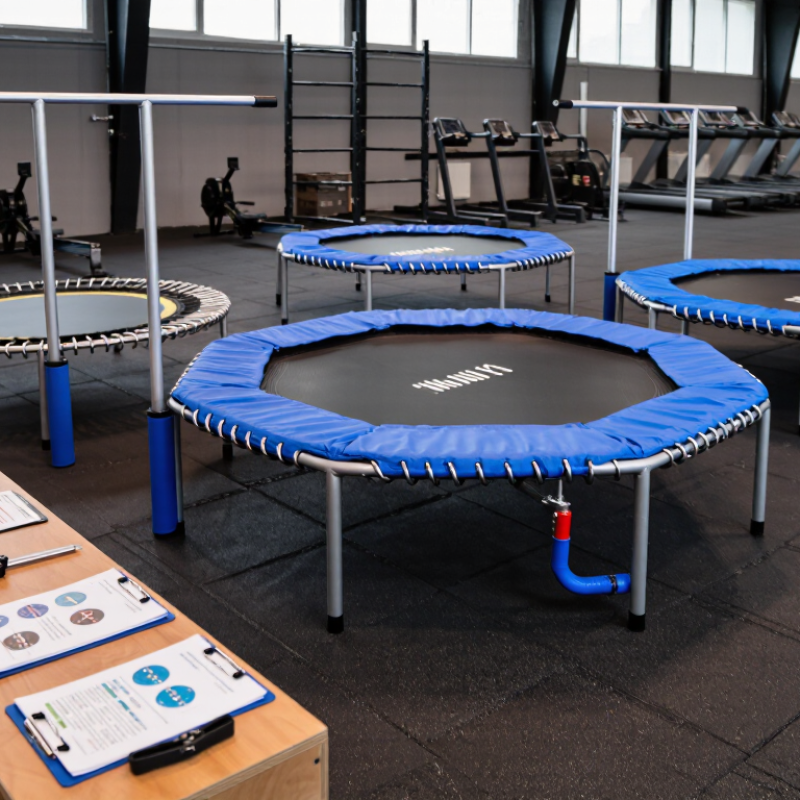
A gym trampoline is specialized training equipment, not simply a backyard bouncing frame. It usually combines a strong steel structure, tensioned springs, a woven jumping mat, and protective padding. Some models include safety nets or adjustable support bars. The design controls rebound, landing stability, and repeated impact during drills.
Coaches use gym trampolines for body control, balance, aerial practice, and rehabilitation exercises. A reliable supplier should understand these different applications. In my experience, product photos are never enough. Buyers need verified dimensions, mat materials, spring counts, load ratings, and clear installation instructions. Small details matter. Uneven padding can change an athlete’s landing confidence.
Global buyers also depend on consistent manufacturing and honest communication. A dependable supplier should provide testing documents, quality-control records, replacement parts, and realistic delivery schedules. Packaging deserves attention too. A damaged frame is expensive to return across borders. Suppliers should explain inspection methods and respond clearly when specifications change. Not every quotation tells the whole story. Buyers may still need independent checks, especially for large orders. That extra step can feel slow, but it often prevents costly surprises. Reliable cooperation is built through evidence, not attractive promises.
Choosing gym trampoline suppliers in 2026 requires more than comparing catalogue prices. Check their manufacturing experience, production capacity, and understanding of professional training environments. A reliable supplier should explain frame materials, spring tension, jumping-bed weave, and padding density in clear terms. Vague descriptions deserve caution.
Inspect the technical details closely. The frame should resist twisting during repeated landings, while the bed must maintain stable tension. Ask for load-test records, dimensional drawings, safety documentation, and samples from current production. Padding should fit tightly, with durable covers and protected seams. Small gaps can become serious maintenance problems. Confirm whether replacement springs, beds, and pads remain available after delivery.
QUALITY CONTROL Supplier reliability also depends on communication and quality control. Request factory inspection photos, batch-check procedures, packaging details, and realistic lead times. A capable team should discuss installation, user weight limits, surface requirements, and after-sales support without avoiding difficult questions. It is useful to compare two samples, not just two quotations. In practice, the cheapest option can create higher costs through damaged parts or delayed repairs. A polished website proves little. Even experienced buyers can overlook spare-part compatibility or indoor humidity conditions. That is worth reviewing twice.
Leading 2026 Gym Trampoline Suppliers by Product Range and Market Reach
Global gym trampoline sourcing is becoming more technical. Grand View Research valued the global fitness equipment market at approximately USD 16.56 billion in 2023. It also forecasts a 5.3% annual growth rate from 2024 to 2030. This expansion supports demand for safer, space-efficient training equipment.
The strongest suppliers usually offer more than one trampoline size. Their ranges may include youth models, competition platforms, rebounders, protective pads, replacement mats, springs, and frame components. Buyers should inspect frame thickness, mat tension, padding density, maximum user weight, and repair access. Small details matter. A loose pad can change training confidence.
Market reach is equally important. Suppliers serving Europe, North America, Asia, and the Middle East should explain export packaging, lead times, spare-part availability, and local compliance documents. The Global Wellness Institute reported that the physical activity economy reached about USD 1.1 trillion in 2022, showing the scale of international demand. Yet market reach does not prove product quality. I would request factory inspection records, batch-testing evidence, installation guidance, and references from comparable gyms. That assumption is risky. Some product pages still provide impressive specifications but weak after-sales support. A practical evaluation should include one sample unit, repeated landing tests, and a written replacement plan.
Leading supplier segments compared by product range and international market reach.
The benchmark uses a 0–100 index based on commonly assessed global sourcing factors, including product-category coverage, OEM/ODM capability, compliance support, export readiness, and regional distribution reach. It compares supplier segments rather than individual companies or brands.
When evaluating gym trampolines, inspect the structure before admiring the finish. Check weld consistency, frame thickness, spring alignment, mat stitching, and edge padding.
A stable trampoline should return evenly after repeated jumps. Ask for load ratings supported by test evidence, not estimates. Request samples, assembly instructions, maintenance schedules, and spare-part lists before placing a large order.
Safety documentation deserves careful review. Depending on the destination market, relevant standards may include EN 13219, EN 913, or applicable ASTM requirements. Requirements vary by product type and country.
Confirm that reports match the exact model, materials, and dimensions you will receive. Reports from an ISO/IEC 17025-accredited laboratory are more dependable.
Also check factory quality controls, batch inspections, coating durability, and anchor-point strength.
A certificate alone is not proof of safe production.
Customization can cover mat size, frame color, padding density, logo placement, packaging, and replacement components. Define these details in drawings and approved samples. Clarify tolerances, delivery checks, and responsibility for damaged parts.
In real procurement work, attractive prototypes sometimes differ from mass production. That gap needs attention. A pre-shipment inspection can catch uneven springs or weak stitching, although it cannot replace regular maintenance.
I would also test the trampoline with repeated loads, because first impressions can be misleading. Safety should remain measurable, documented, and easy for staff to verify.
2026 Top Gym Trampoline Suppliers for Global Buyers
Global buyers should judge gym trampoline suppliers beyond catalog prices. The Sports & Fitness Industry Association reported 242.3 million U.S. participants in at least one sport or fitness activity in 2023. This demand increases pressure on suppliers to provide stable quality. Request load-test records, frame material details, safety padding specifications, and factory inspection photos. Confirm production capacity before placing a large order. A low quote can still become expensive.
Shipping needs equal attention. The World Bank’s 2023 Logistics Performance Index found that international shipments can spend about 44 days moving through logistics processes. Ask suppliers for FOB, CIF, or DDP quotations with clear cost boundaries. Confirm carton dimensions, pallet counts, port options, insurance, and tracking responsibility. Pricing should include spare parts and packaging upgrades. Otherwise, the final landed cost may surprise you.
Tips: Start with a sample and a written inspection checklist. Test rebound consistency, stitching, welds, and folding mechanisms. Require a digital packing list before dispatch. After-sales support should define response times, replacement-part availability, and claim procedures. A practical target is a reply within two business days. Keep photos and serial numbers for every shipment. Some suppliers promise fast support but provide vague answers later. That gap deserves careful review.
| Supplier Profile | Primary Product Focus | Typical Commercial Order | Indicative Factory Price Range | Common Compliance Documentation | Production Lead Time | Shipping Options | Estimated Ocean Transit | Sample & Inspection Policy | Warranty & Spare Parts | Best Fit for Global Buyers |
|---|---|---|---|---|---|---|---|---|---|---|
| Profile A ★★★★☆ | Commercial fitness trampolines, rebounders, protective skirts, and replacement mats | 20–50 units for standard models; private-label orders usually start at 100 units | US$85–210 per unit | Material test reports, load-capacity reports, factory quality-control records, and packaging specifications | 25–40 days after approval of specifications and deposit | FOB, CIF, and DDP quotations available depending on destination and order size | Approximately 25–45 days to major European and North American ports | Paid sample normally available; third-party pre-shipment inspection can be arranged at buyer cost | Typical 12-month limited warranty; common spare parts supported for 2–5 years | Gyms, rehabilitation centers, and distributors requiring a balanced price-to-volume model |
| Profile B ★★★★★ | Heavy-duty studio trampolines with reinforced frames, high-frequency springs, and replaceable covers | 10–30 units for standard products; custom engineering generally requires 50+ units | US$150–360 per unit | Structural testing, corrosion-resistance information, user instructions, carton-drop testing, and traceability records | 30–50 days for standard production; longer for custom tooling | FOB and CIF are common; consolidated freight may be suitable for smaller multi-model orders | Approximately 20–40 days to major ports, excluding customs clearance | Functional sample recommended before bulk production; factory or independent inspection available | Typical 12–24-month limited warranty; frame and mat components may have separate coverage terms | Premium fitness clubs and buyers prioritizing durability and long-term component availability |
| Profile C ★★★★☆ | Entry-level commercial rebounders, compact folding units, and promotional gym equipment | 50–100 units for standard models; mixed-model container orders may be negotiated | US$55–140 per unit | Basic product specifications, packaging data, material declarations, and applicable market-labeling files | 20–35 days after artwork and order confirmation | FOB, FCA, and courier delivery for samples; container shipping preferred for bulk orders | Approximately 25–50 days depending on route and port congestion | Sample purchase required in most cases; buyer should confirm dimensions, stitching, frame finish, and stability | Typical 12-month limited warranty; spare springs, feet, mats, and covers commonly available | New distributors, budget-conscious gyms, and buyers testing a new market |
| Profile D ★★★★☆ | Large-format gym trampolines, modular training systems, safety padding, and installation accessories | 5–15 complete systems; project-based orders may be quoted individually | US$480–1,800 per system | Installation drawings, structural calculations, safety instructions, component lists, and project-specific inspection records | 45–75 days depending on design approval and installation requirements | Project cargo, FOB, CIF, and door-to-door logistics through appointed freight forwarders | Approximately 30–55 days by sea, plus destination installation and customs time | Technical drawing review and factory acceptance inspection recommended before dispatch | Typical 12-month system warranty; technical support and replacement components usually quoted by project | Indoor sports facilities, performance centers, schools, and multi-site gym projects |
| Profile E ★★★★☆ | Private-label gym trampolines, color-matched frames, branded packaging, and retail-ready accessories | 100–300 units for custom packaging; lower quantities may be possible for existing designs | US$95–260 per unit | Artwork approvals, barcode and carton specifications, material declarations, product manuals, and shipment inspection records | 35–60 days, including packaging and label approval | FOB, CIF, DDP, and air freight for urgent replenishment orders | Approximately 25–50 days by sea; air freight generally takes 5–12 days after dispatch | Pre-production sample recommended; packaging and color approval should be documented in writing | Typical 12-month limited warranty; replacement parts may be supplied under a rolling after-sales agreement | Importers, online retailers, and fitness-equipment chains building a private-label range |
| Profile F ★★★☆☆ | Basic home-to-gym crossover rebounders and small-batch customizable equipment | 10–40 units for standard items; custom colors and accessories may require additional quantities | US$70–175 per unit | Product datasheets, user manuals, basic quality records, and destination-market labeling review | 20–45 days after deposit and specification confirmation | Courier, air freight, LCL, and FOB services depending on order volume | Approximately 25–55 days by sea, depending on consolidation and destination | Sample and video inspection commonly available; independent inspection should be considered for first orders | Typical 6–12-month limited warranty; spare-part availability should be confirmed before payment | Small gyms, studios, pilot programs, and buyers placing low-volume trial orders |
| Indicative 2026 market ranges for commercial purchasing. Final pricing, lead time, freight cost, duties, taxes, compliance requirements, warranty terms, and minimum order quantity should be confirmed in a written quotation before ordering. Ocean transit estimates exclude customs clearance, inland delivery, port delays, and installation. | ||||||||||